


Traveling from Narita International Airport to Tokyo
If you're visiting Tokyo, Japan, you'll most likely land at Narita Airport (Narita International Airport), the main international airport serving the city. It is located in Narita, Chiba Prefecture, about 60 kilometers from central Tokyo. The journey takes around an hour, depending on which transport method you choose. Many first-time visitors to Tokyo worry about how to get into the city, and with so many transport options available, it can feel overwhelming. Don't worry, though — we've put together a detailed guide covering every way to travel from Narita Airport to Tokyo, so even first-timers can travel smoothly. Transport into Tokyo falls into three main categories — train, bus and taxi — and each one offers several options.
Before explaining each way to travel between Narita Airport and Tokyo, here are a few short tips to consider when choosing your transport method from the airport:
- First, know which part of Tokyo you want to reach. This is the most important question, since Tokyo is a huge city and your destination greatly affects which transport method suits you best. Many options only take you to one specific point in Tokyo, so if that point is far from where you're actually going, you'll spend more time and money.
- How much luggage do you have? Some options provide luggage storage space, while others have none or very limited space.
- Are you traveling with children or elderly family members? Changing trains in Tokyo during rush hour can easily turn into a nightmare for your trip.
- Do you want the fastest, the cheapest, or the most comfortable option?
Now let's look at all 9 ways to travel from Narita Airport to Tokyo.
Train
Train travel is considered the fastest and most convenient way to travel between Narita Airport and Tokyo, compared to other options which tend to be slower. Trains depart from different terminals: Terminal 1 has Narita Airport Station, while Terminals 2–3 have Narita Airport Terminal 2 Station. There are currently 5 main train lines. For every line, you can buy tickets at counters inside Narita Airport at Terminals 1–3, or purchase online. Two train companies operate these services: JR East, which runs the Narita Express (N'EX) and the JR Sobu Line; and Keisei Electric Railway, which runs three services — the Keisei Skyliner, Access Express, and Keisei Main Line. Ticket counters are open from 7:00 AM to 9:00 PM. The JR East Travel Service Center and the Skyliner & Keisei Information Center are located at Terminal 1 and Terminal 2. Automatic ticket machines at every terminal are open 24 hours.
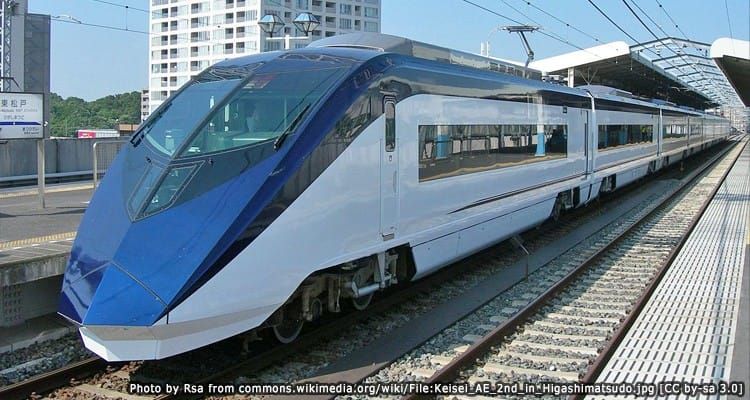
The Keisei Skyliner is a limited express train and the fastest way to travel between Narita Airport and Tokyo. It reaches Nippori Station in about 36 minutes and Ueno Station in about 41 minutes, running non-stop apart from these two stops. Trains depart every 20–40 minutes, with about 2–3 departures per hour. Advance booking fares start at 2,520 yen one way for adults, or 4,940 yen round trip (children's tickets are about half price).
What makes this train special is its premium comfort: wide, comfortable paired seats, charging outlets, and free Wi-Fi. You can also add extra tickets such as the Tokyo Subway Ticket for unlimited subway rides (1–3 day options), the Teito Taxi service, which lets you book a taxi to meet you at your destination station (about 3,000–60,000 yen), and the Hands-Free Travel service, which delivers your bags straight to your accommodation for about 4,210 yen. It's a highly convenient option.
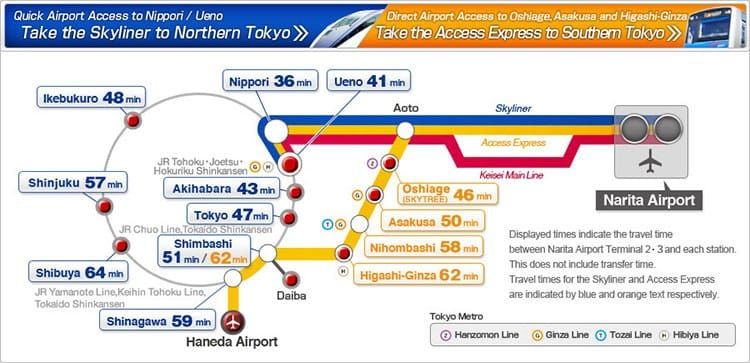
In short, if you're heading to Ueno or Nippori, this is the option we recommend. For other stations, you'll need to transfer to a regular train, which may be inconvenient if you have a lot of luggage.
- Approximate duration: About 41 minutes to Ueno
- Cost: From ¥2,520, or ¥4,940 round trip
- Pros: Fast and convenient
- Cons: Expensive

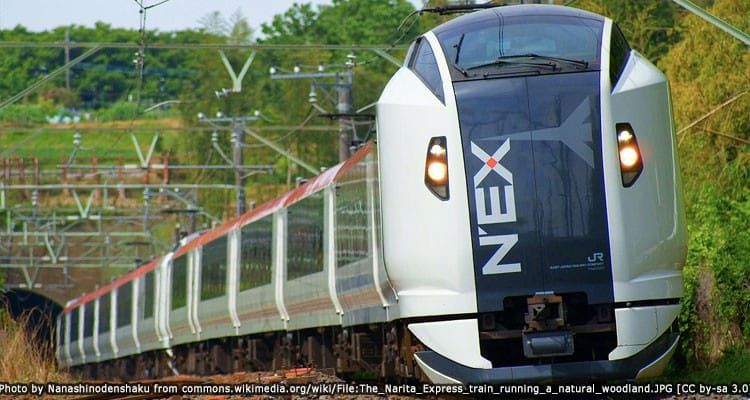
Another popular way to reach Tokyo, this premium limited express train takes about 53 minutes to reach Tokyo. It's operated by JR, so the JR Pass is valid, and seats are all reserved. There are two seat classes: standard and first class (Green Car), which costs about 50% more. The train serves several destination stations — Tokyo, Shinagawa, Shibuya, Shinjuku, Ikebukuro, Omiya, Yokohama, and Ofuna — with fares varying by station. One-way fares start at 3,250 yen to Tokyo Station, with the same 3,250 yen fare to Shinagawa, Shibuya, and Shinjuku, and fares to other stations rising to as much as 4,700 yen. Children aged 6–11 pay half price. Round-trip tickets have a flat fare for all stations: 5,000 yen for adults and 2,500 yen for children, except for the Green Car, which has no discount.
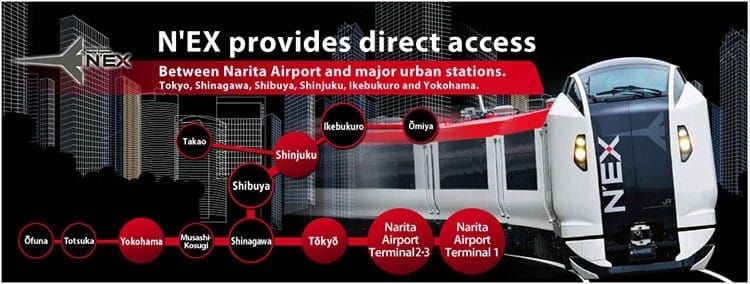
In short, if you're not heading to Ueno, this is the option we recommend.
Note: Make sure you board the correct train, since there are two routes — one ending at Ofuna and one at Omiya. If you're heading to Shibuya, Shinjuku, or Ikebukuro, you must take the train bound for Omiya.
- Approximate duration: About 53 minutes to Tokyo Station
- Cost: From ¥3,250, or ¥5,000 round trip
- Pros: Stops at multiple stations in central Tokyo, valid with the JR Pass
- Cons: Expensive
This train takes about 64 minutes to reach Tokyo, ending at Ueno Station, with stops along the way at Asakusa, Nihombashi, Higashi-Ginza, and Nippori. What's notable is that it's considerably cheaper than the two trains above, at about 1,330 yen. Seats are unreserved, so you can choose your own seat, and unlike the first two trains, there's no dedicated luggage storage. It connects to the Tokyo subway network and Haneda Airport.
Overall, this option is a middle ground — not the fastest, not the slowest, and not the cheapest.
- Approximate duration: 64 minutes to Ueno Station
- Cost: ¥1,330
- Pros: Affordable
- Cons: Takes longer
This is a regular local train and the cheapest option, but it also takes the longest — about 80–90 minutes, since it stops at every station along the way. It ends at Ueno Station. Travelers with lots of luggage may find it inconvenient, since there's no storage space. Its best feature is being the cheapest of all the train options, at about 1,030–2,470 yen. It also connects to the Tokyo subway network and Haneda Airport.
This option is great if you're on a limited budget but still want a reliable, predictable travel time, and don't have much luggage.
- Approximate duration: 80–90 minutes to Ueno Station
- Cost: ¥1,030
- Pros: Cheapest option
- Cons: Longest travel time
Bus
This is a very popular option among travelers, especially first-timers, since it's simple and hassle-free. Compared to trains, where you need to catch the right train at the right time, buses are easier — staff are on hand to help, and you don't need to worry about your luggage. Some routes have many stops close to train stations, and you also get to enjoy the city view along the way. Importantly, buses are cheaper than trains, especially if booked in advance. Ticket counters at every terminal (1–3) are easy to find near the ground floor exits — just look for the Terminal Shuttle Bus signs. Several companies operate these buses, such as Airport Limousine Bus and Keisei Bus. The main downside is traffic, which can make the journey longer than expected — a normal 1-hour trip could stretch to 2 hours during heavy traffic.
Besides the dedicated airport shuttle buses, there are also regular public buses, with many routes covering the Tokyo area. You can simply wait at the stop and board according to each route's sign. This is the cheapest option, but it's not recommended for first-timers or travelers with a lot of luggage, since it's more complicated and has no dedicated luggage space.
- Approximate duration: 60–100 minutes, depending on your destination in Tokyo and traffic conditions
- Cost: ¥1,000–¥3,200
- Pros: Convenient, as it drops you off close to your hotel
- Cons: Travel time depends on traffic conditions
This bus stops at almost every major train station, as well as major hotels in Tokyo. If you're heading to Disneyland, this bus stops there too. Ticket counters are only available at Terminals 1 and 2. The journey takes just over an hour. One-way adult fares are about 2,000–3,000 yen, or 4,000–6,000 yen round trip. The bus has Wi-Fi and charging outlets.
In short, this is a comfortable, upscale way to travel — even better if there's a stop close to your destination.
This bus is run by Keisei, the same company behind the Skyliner mentioned above. Adult fare is 1,300 yen, and children ride for 650 yen. It stops at major locations such as Shinonome Aeon Mae, Shinonome Shako, Ginza Station, and Tokyo Station. Buses run from Narita Airport between 5:55 AM and 11:10 PM.
In short, this is one of the cheapest ways to travel from Narita to Tokyo.

This bus is run by JR jointly with Keisei Bus. It only runs between Tokyo Station and Narita Airport. The adult fare is also 1,300 yen.
In short, this is one of the cheapest ways to travel from Narita to Tokyo.
Another dedicated airport shuttle bus company. Booking at least 24 hours in advance costs 1,000–1,500 yen for adults and 950 yen for children. If you miss booking online or at the counter, you can buy tickets on board. It runs between Ikebukuro Station and Narita Airport Terminals 1, 2, and 3.
Taxi
If you're feeling unsure, worried about getting lost, exhausted from your journey and just want to rest, and you're willing to pay more, a taxi is probably your best option. The fare depends on your destination. The taxi pickup point is near the bus stops on the ground floor of the terminal. A ride from Narita Airport to Ueno typically costs around 25,000 yen or more. There are two options: a shared large taxi that waits until it's full before departing, or a chartered minivan taxi or limousine. These fares don't include additional costs like expressway tolls, which are charged separately. This is by far the most expensive way to travel, but also the most comfortable, since it takes you right to your hotel's front door.
Travel Options for Late-Night Arrivals at Narita Airport
If you arrive at Narita Airport late at night, there are several options available, depending on what time you clear immigration and collect your luggage.
▌1. Late-Night Trains
1.1 Narita Express (N'EX):
The Narita Express runs until about 9:45 PM from Narita Airport to major Tokyo stations such as Tokyo Station, Shinjuku, and Shibuya.
Pros: Direct access to major Tokyo stations, convenient, and valid with the JR Pass
Tip: Check the schedule in advance and buy tickets online or at the airport for convenience.
1.2 Keisei Skyliner:
The last Keisei Skyliner departs Narita Airport at about 10:30 PM, heading to Ueno Station.
Pros: Fast and convenient, ideal for travelers heading to Ueno or connecting to other major subway lines.
Tip: Book tickets in advance and check the train schedule before you travel.
▌2. Late-Night Buses:
Tip: Some limousine bus routes run until around midnight. Check the schedule in advance.
Pros: Serves major hotels in Tokyo
▌3. Airport Transfer Services:
Tip: Book a private transfer service in advance.
Pros: Convenient and reliable for nighttime travel
▌4. Taxi:
Tip: A taxi is a good option if no other public transport is available.
Pros: Available 24 hours, though at a higher price
▌5. Hotels Near the Airport:
Tip: Consider hotels at Narita Airport or nearby hotels offering free shuttle service.
Pros: Convenient, letting you rest before heading into Tokyo the next day
Luggage Delivery Services
If you'd like to send your luggage from the airport to your accommodation in the city, you can contact luggage delivery services at the arrival terminal, such as the JAL ABC Counter (website: http://www.jalabc.com) or QL Liner (tel: 0476-35-2864). Fees depend on the weight of your luggage — for example, bags up to 20 kg cost up to 2,000 yen. For sending luggage from your hotel or the city to the airport or elsewhere, you can contact your hotel or a convenience store.
FAQs: Traveling Between Tokyo and Narita Airport
1. Are there discounts for round-trip tickets?
Yes. JR East offers the N'EX Tokyo Round Trip Ticket for foreign tourists at a discounted price, valid for 14 days from the date of purchase.
2. Can I use the Japan Rail Pass on the Narita Express?
Yes, the Japan Rail Pass is valid on the Narita Express.
3. How frequently do trains and buses run?
The Narita Express and Keisei Skyliner run frequently, roughly every 10–30 minutes during peak hours. Airport Limousine buses also run regularly, typically every 20–30 minutes.
4. Are there nighttime travel options from Narita Airport?
Nighttime travel options are limited. Some buses run at night, but train service usually ends around 11:00 PM. Check schedules in advance, or consider staying near the airport if you arrive late.
5. Is it easy to find transport options inside Narita Airport?
Very easy. Narita Airport has clear English signage, and information desks with staff ready to help you find the right transport option.
Additional Tips for Traveling from Narita Airport to Tokyo
Consider Luggage Delivery Services:
If you have a lot of luggage, consider using a luggage delivery service (Takkyubin) to send your bags directly to your hotel, making your journey more convenient.
Discounts:
Many transport options come with discounts and packages for foreign tourists, such as the N'EX Tokyo Round Trip Ticket or the Keisei Skyliner & Tokyo Subway Ticket package.
Allow Time for Traffic:
If you choose the Airport Limousine Bus, keep in mind that Tokyo traffic can be unpredictable, especially during rush hour, so allow extra time for delays.
Navigation Apps:
Use navigation apps like Google Maps or Japan Travel by NAVITIME to check real-time schedules and platform information. These apps can also help you navigate Tokyo's extensive public transport network.
Tokyo Peak Hours:
Avoid traveling during peak hours (7–9 AM and 5–7 PM) if possible, as trains and buses get very crowded.
Currency and ATMs:
ATMs and currency exchange services are available at Narita Airport.
Free Wi-Fi:
Narita Airport offers free Wi-Fi, which you can use to check schedules and navigation apps upon arrival.

Comparing Narita Airport and Haneda Airport: Narita vs Haneda
Narita Airport (NRT) and Haneda Airport (HND) are the two main airports serving the Tokyo area, each with its own characteristics and drawbacks. If you're deciding which one to use, here's a comparison below.
Narita Airport (NRT)
- International Flights Focus: Although it's about 60 kilometers from central Tokyo, Narita Airport has more international flights, served by around 80 airlines with 117 routes, making it popular for long-haul travel.
- Cost: A good choice for budget-conscious travelers, as many low-cost airlines operate here. Although the trip into the city takes longer, there are convenient transport options such as the Narita Express and the Skyliner.
- Facilities: Offers a wide range of amenities, including more lounges, shops, and various dining options, as well as rest rooms.
Haneda Airport (HND)
- Location: Just 15 kilometers from central Tokyo, making the trip into the city quicker and more convenient.
- Flight Options: Haneda has a growing number of international flights and extensive domestic coverage, served by around 45 airlines with 104 routes, making it ideal for business travel.
- Facilities: Offers modern amenities, shops, restaurants, and premium lounges, although it has fewer international lounges compared to Narita Airport.
So, if you want quick and convenient access into Tokyo, Haneda Airport is a great choice. But if you want more international flight options and lower costs, Narita Airport might suit you better. Consider your travel plans, accommodation, and specific needs when choosing an airport.