


Getting to Kyoto
Recommended article ▶︎ Latest information on popular attractions in Kyoto
Traveling from Tokyo to Kyoto
Shinkansen (bullet train)- Take the JR Tokaido Shinkansen to Kyoto. The Nozomi train takes 140 minutes and costs ¥14,000 (reserved seat). The Hikari train takes 160 minutes, and the Kodama train takes 4 hours, costing ¥13,080/13,500. The JR Pass can be used on the Hikari and Kodama trains (the Nozomi requires an additional special ticket).
There is also an E-Voucher for foreign tourists only, which includes a round-trip Nozomi/Hikari ticket between Tokyo and Osaka combined with a 1-day Kyoto Sightseeing Card for subway and bus travel in Kyoto, priced at ¥21,600. The return ticket must be used within 7 days. There is also a Shinkansen Tour ticket that includes a one-way trip and a hotel stay in Kyoto, starting at ¥15,400, or a round-trip package for about ¥20,400.
The Puratto Kodama Economy Plan allows travel between Tokyo and Kyoto on the Kodama train for just ¥10,100. This ticket must be purchased at least one day before travel through a JR Tokai travel agency.
Highway Bus- Takes 7-8 hours, with both daytime and overnight buses available. Costs range from about ¥3,500 to ¥10,000 depending on comfort level, or from ¥3,000 to ¥10,000 with discount services such as Willer Express.
Flights- Several airlines operate flights between Tokyo and Kyoto, departing from Haneda Airport and arriving at Itami Airport, with some flights also departing from Narita Airport. The fare is about ¥23,000, or as low as ¥9,000-16,000 with promotions. The flight takes about 1 hour.
Car- Takes 5-6 hours via the Tomei Expressway and Meishin Expressway (without stops and assuming no traffic). Expressway tolls cost about ¥10,000.
Local Train- Takes 9 hours with 4 train changes, costing about ¥8,210, or use the JR Seishun 18 Kippu for a further discount, bringing the cost to ¥2,370.
Traveling from Kansai Airport to Kyoto
JR Haruka Limited Express- Travel from Kansai Airport to Kyoto Station (70 minutes, ¥2,850/3,500), departing every 30 minutes. There is also the Icoca&Haruka package for ¥3,030, sold only to foreign tourists, which includes a non-reserved Haruka train ticket from the airport to Kyoto plus an Icoca card usable for trains, subways, and buses in Kyoto (normally with a minimum charge of ¥2,000). There is also a round-trip airport-city package with an Icoca card for ¥4,060 (though a one-way airport ticket is not sold separately), or the 1-day JR Kansai Area Pass for ¥2,200, which saves ¥200 compared to the regular Haruka fare.
JR Airport Rapid- Take the JR Airport Rapid train to Osaka Station, then transfer to the JR Kyoto Line special rapid train. The whole journey takes about 100 minutes and costs ¥1,880.
Nankai Railways and Hankyu Railways- Take the Nankai Express train to Tengachaya Station (40 minutes, ¥920), then transfer to the Sakaisuji Subway Line and Hankyu Kyoto Line to reach central Kyoto (60 minutes, ¥680; you can transfer lines at Awaji Station, Ibarakishi Station, or Takatsuki Station). The whole journey takes 120 minutes. You can also use the "Kyoto Access Ticket/Kanku Access Ticket," which covers the train fare for ¥1,230 one-way and can also be used in Kyoto and around Shijo-dori Street.
Nankai Railways and Keihan Railways- Take the Nankai Express train to Tengachaya Station (40 minutes, ¥920), then take the Sakaisuji Subway Line to Kitahama Station (10 minutes, ¥240). From Kitahama, take the Keihan Main Line into central Kyoto (50 minutes, ¥410). This route is worthwhile for travelers planning to visit eastern Kyoto along the Keihan Line, such as Higashiyama or Gion.
Bus- Takes 100 minutes and costs ¥2,550. Buses depart every 1-2 hours.
Taxi- Takes 90-150 minutes. Costs ¥3,600 per person for a shuttle service (a small bus), or ¥20,000-25,000 for a regular taxi.
Traveling from Osaka to Kyoto
Shinkansen- Take the JR Tokaido Shinkansen from Shin-Osaka Station (15 minutes, ¥1,420). The JR Pass can be used on the Hikari and Kodama trains (the Nozomi requires an additional special ticket).
JR Special Rapid- Take the JR Kyoto Line special rapid train from Osaka Station (30 minutes, ¥560), or the rapid train (40 minutes), or the local train (45 minutes, ¥560, usually less crowded). The JR Pass can be used.
JR Limited Express- Takes 30 minutes and costs ¥1,210-1,930. The JR Pass can be used.
Hankyu Railways- Take the Hankyu Kyoto Line limited express train from Umeda Station (near JR Osaka Station) to Karasuma Station or Kawaramachi Station (40 minutes, ¥400). The JR Pass cannot be used.
Keihan Railways- Take the Keihan Main Line limited express train from Yodoyabashi Station to Sanjo Station (50 minutes, ¥410). The JR Pass cannot be used.
Traveling from Kobe to Kyoto
Shinkansen- Take the Hikari train from Shin-Kobe Station (30 minutes, ¥2,810), or the Nozomi train. The JR Pass can be used on the Hikari train (the Nozomi requires an additional special ticket).
JR Special Rapid- Take the JR Tokaido Line (Kyoto Line/Kobe Line) special rapid train between Kyoto Station and Sannomiya Station (50 minutes, ¥1,080).
Hankyu Railways- Take the Hankyu Kyoto/Kobe Line limited express train between Karasuma Station (Kyoto) and Sannomiya Station (Kobe), transferring at Juso Station (1 hour, ¥620).
Traveling from Nara to Kyoto
JR Train- Take the Miyakoji Rapid train (45 minutes, ¥710). The JR Pass can be used. Alternatively, the local train takes 75 minutes for the same fare of ¥710.
Kintetsu Railways- Take the limited express train between Kyoto Station and Kintetsu Nara Station (35 minutes, ¥1,130), or the express train (45 minutes, ¥620). Some express trains require a transfer at Yamato-Saidaiji Station. The JR Pass cannot be used.
Traveling from Nagoya to Kyoto
Shinkansen- Take the JR Tokaido Shinkansen. The Nozomi train takes 35 minutes, or the Hikari and Kodama trains take 40-60 minutes, costing ¥5,070/5,500. The JR Pass can be used on the Hikari and Kodama trains (the Nozomi requires an additional special ticket).
The Puratto Kodama Economy Plan allows travel between Tokyo and Nagoya on the Kodama train for just ¥4,200. This ticket must be purchased at least one day before travel through a JR Tokai travel agency.
Foreign tourists traveling from the Nagoya area to Kyoto can purchase the Free Plan Kyoto 2 Days package (from JTB), which covers round-trip fare between Nagoya and Kyoto on the Kodama Shinkansen plus 1-2 nights at a hotel in Kyoto, starting from ¥12,100.
JR Local Train- Take the JR Tokaido Line local train, transferring at Maibara Station (2 hours 15 minutes, ¥2,590).
Bus- Take a daytime bus from Nagoya Station (2.5 hours, ¥2,500 one-way or ¥4,100 round-trip).
Traveling from Itami Airport to Kyoto
Bus- Takes 1 hour and costs ¥1,310.
Monorail and Hankyu Railways- Take the Osaka Monorail from the airport to Hotarugaike Station (2 minutes, ¥200), then transfer to the Hankyu Takarazuka Line to Juso Station, and transfer again to the Hankyu Kyoto Line into Kyoto (55 minutes, ¥470 from Hotarugaike Station).
Monorail and JR- Take the Osaka Monorail from the airport to Hotarugaike Station (2 minutes, ¥200), then transfer to the Hankyu Takarazuka Line to Umeda Station (15-20 minutes, ¥220). From Umeda/Osaka Station, take the JR Kyoto Line to Kyoto (30 minutes, ¥560).
[wp_ad_camp_1]
Getting Around Kyoto
Kyoto's street network forms a grid pattern, with major streets running east-west and north-south, spaced about 500 meters apart. The main train station is JR Kyoto Station, located in the southern part of the city.
Kyoto's transportation system includes buses, trains, and subways, and cycling around the city is also an option. An IC card such as Icoca is recommended for travelers, as it works on both trains and buses in the city. Another option is a 1-day pass, as detailed below.
Bus
Kyoto's bus network covers more attractions than the subway or train, starting from Kyoto Station and the city center around Shijo-dori and Kawaramachi-dori. Several bus companies operate here, including the green Kyoto City Bus, which has a large number of routes, and the red Kyoto Bus, which tends to run closer to tourist attractions.
Tourist information centers offer English-language support to help foreign visitors use the buses more easily. Buses can get very crowded on weekends and public holidays, so keep an eye out for your stop.
How to ride the bus: Board through the rear or front door and pay when you get off. The fare is ¥230 per ride within the city of Kyoto. Traveling outside the city costs more depending on the distance.
Subway
The subway consists of two lines: the Karasuma Line, running north-south along Karasuma-dori and stopping at JR Kyoto Station, and the Tozai Line, running east-west, crossing Karasuma-dori and Oike-dori.
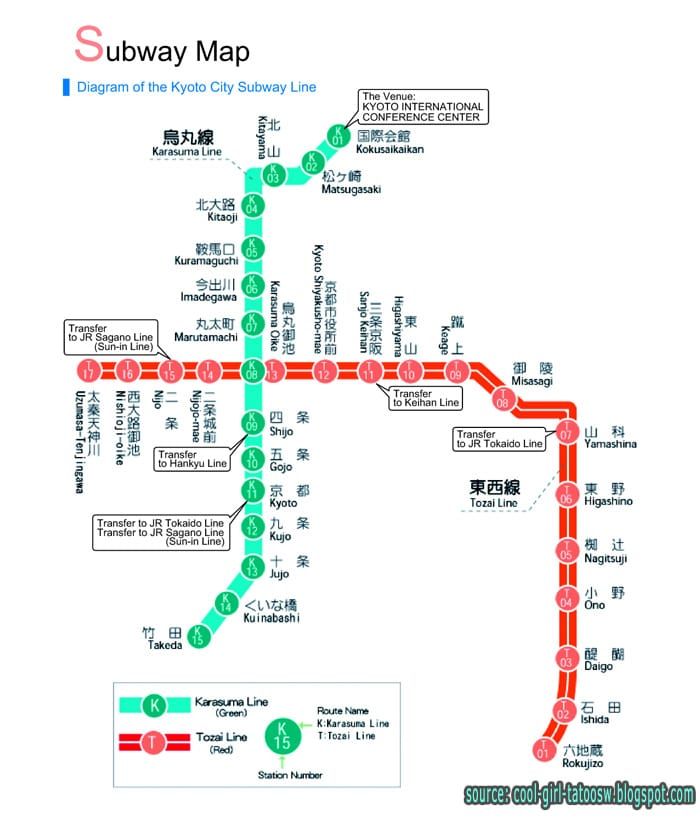
Kyoto Subway Map
JR Train
All JR lines, including the Tokaido Shinkansen, stop at JR Kyoto Station, making it convenient for travelers heading to Arashiyama on the Sagano Line, and attractions in southern Kyoto (JR Nara Line) such as Fushimi Inari Taisha and Byodo-in Temple in Uji
Private Railways
- Hankyu Railways- Connects Kyoto with Osaka, running west from Kawaramachi. This line is convenient for reaching the Katsura Rikyu area of Kyoto, and also has a route to Arashiyama.
- Keifuku Railways- Operates two tram lines in the northwestern part of Kyoto, convenient for reaching Arashiyama and the areas around Ryoan-ji Temple andKinkaku-ji Temple
- Keihan Railways- The main line runs parallel to the Kamo River but does not connect to Kyoto Station, continuing on to Osaka. It offers an alternative route to the JR Nara Line coming from southern Kyoto.
- Eizan Railways- Operates two lines from Demachiyanagi Station, the northern terminus of the Keihan Line. One route heads to Kurama, and the other heads to Mount Hiei.
- Kintetsu Railways- Connects Kyoto Station with Nara. Some Karasuma Subway Line trains also continue onto the Kintetsu Nara Line.
Bicycle
Kyoto's streets are relatively flat, making it easy to explore the city by bicycle. Bicycles can be rented from many shops, especially near Kyoto Station and popular cycling areas such as Arashiyama. Rental costs about ¥1,000-1,500 per day, or ¥1,700-2,000 per day for an electric bicycle. Some hotels also offer bicycle rentals or free bicycle use.
Here are some cycling routes recommended by our website:
Taxi
Taxis are widely available, especially in central Kyoto, making them convenient for groups of 3-4 people (a standard taxi seats 4 passengers, not including the driver, while a larger taxi seats 5). The meter starts at ¥650 for the first 2 kilometers, then increases by ¥80 every 300-400 meters.